

Before we go any further, we need a model. What follows is a description of how the human organism continuously maintains its integrity within reality across multiple stacked layers of recursion.
This article introduces the Human Recursion Stack: a biologically grounded, evolutionarily layered architecture that explains how perception, feeling, thought, meaning, and understanding emerge—and why they sometimes collapse into fear, confusion, or suffering.
To understand why these layers exist, we must return briefly to the logic introduced in The Recursion of Life. Life persists through recursive self-adaptation in the face of uncertainty under consequence. When environmental conditions shift, internal conditions drift away from viability. If the system corrects the deviation fast and precise enough, it continues; if it cannot, it dissolves. As environments grew more complex across evolutionary time, earlier means for stabilization became insufficient on their own. New regulatory layers emerged to detect and correct deviation earlier and more efficiently. Each layer of the recursion stack is therefore an evolutionarily selected arbitration regime to guide self-corrective action in order to remain viable within a particular type of uncertainty. Each new one came about because the layer beneath it eventually became insufficient to stabilize the organism under the increasing complexity of its signal environment.
At its core, the Human Recursion Stack answers one question:
How do we repeatedly compare ourselves to the external world, detect deviation, and adjust under consequence?
Everything we call experience happens inside that loop.
Layer 0 — Living Substrate
Close ↔ Open
At the base is the living boundary. Cell membranes open and close. Ion channels regulate gradients. Metabolic loops maintain temperature, pH, and energy balance. This layer does not represent the world. It couples to it.
The recursion here is immediate: deviation is detected, compensation occurs, a new state emerges—continuous homeostasis.
This is the primordial operator. Every higher layer is a more layered version of this same loop: compare, adjust, repeat.
When higher layers ignore this one, collapse follows—injury, illness, exhaustion. The body always speaks first.
Layer 1 — Instinct
Contraction ↔ Dilation
When environmental patterns and their effects on the substrate became reliable enough to reward patterned detection and reaction as prevention, instinct emerged.
Instinct compresses immediate substrate health into action, non-action (if safe) or dilation (if exceptionally safe). Brainstem reflexes and spinal programs map certain stimulus patterns directly to substrate outputs: fight, flee, freeze, orient, grasp, etc.
The recursion is fast. Certain selected and encoded patterns of substrate signals trigger movement, movement alters sensory input, readiness updates. No interpretation. No deliberation.
It only executes what has been encoded to preserve substrate viability.
Instinct is not primitive in a pejorative sense. It is precise, fast, and life-preserving. An ancient lifeguard that is always on duty and protects the integrity of the living substrate when required. If a signal does not indicate imminent or ongoing consequential substrate damage, it passes upward.
Layer 2 — Valence
Repulsion ↔ Attraction
Yet instinct alone could not effectively guide behavior across new, more diverse and changing environments. Systems that were more successful at distinguishing conditions that historically supported survival from those that did not persisted.
Here, the organism begins to feel. Not emotion yet—valence. Pleasant or unpleasant. Nourishing or depleting. Warm or harsh.
Interoceptive systems bind bodily state to stimulus features, creating gradients of pull and push. Over time, repeated exposures tune these gradients.
Valence is a compressed survival utility. It turns signal patterns into an internal landscape. The world begins to feel like something.
This layer answers a simple question: Should I engage with this, or disengage from it?
Layer 3 — Relational Instinct
Withdraw ↔ Approach
As life grew more plentiful, encountered environments no longer consisted of static objects only. They started to contain other adaptive, possibly hostile agents. This introduced yet another form of uncertainty and with it, relational instinct.
With other agents present, the environment becomes dynamic in a new way. Faces, voices, posture, tone—these signals predict behavior. This layer models others not symbolically, but heuristically.
The recursion is iterative and fast: cue, prediction, micro-adjustment, new cue. The system constantly updates expectations of near-term social outcomes.
This is where “other” appears as a system. It is also where social rupture begins to matter.
Most people underestimate how much of their daily behavior is governed here. This layer operates pre-symbolically, yet it strongly biases what cognition later interprets.
Layer 4 — Emotion
Suppression ↔ Expression
As multiple weaker systems found that cooperation with one another increased survival chances for everyone, interaction between agents ceased to unfold in isolated moments only. Instead, relations started to extend across time. To stabilize this new relational uncertainty for the one within the multiple—another regulatory layer was rewarded into being.
Emotion integrates even more signals over time. A memory of prior affective experiences enters the loop. The system now compares current relational and experiential states against a history of prior states.
Emotion answers: How is this feeling for me, given what has happened before? It continuously assesses incoming signal against the past and adjusts output to stabilize favorable states.
This is coherence-checking in the affective domain. When emotion is ignored or suppressed for too long, the system loses its ability to accurately assess and beneficially influence relational reality across time and instead begins to loop defensively.
Emotion is not irrational. Emotion is an affective comparator across time. When suppressed to preserve relational or symbolic coherence, distortion accumulates.
But even emotional regulation started becoming insufficient once group interactions became more uncertain than prior relational experience could predict.
Layer 5 — Cognition
Fear ↔ Curiosity
More agents became part of the group than the organism could realistically have a history of relations with. At this point the organism needed a way to simulate possible futures based on incomplete relational information before acting, to gauge a range of possible consequences before committing.
Cognition models possibilities. The prefrontal cortex simulates futures, infers causality, evaluates tradeoffs, and generates explanations. It only recurses on incoming signals if no lower layer has crossed into hijacking execution at that layer. It inherits the lower layers’ weightings and then attempts to place the signal into a safely bounded, agency-preserving, executable domain.
This is full recursion: remember the past, represent the present, imagine alternatives, evaluate consequences, coordinate action, update the model. It allows delayed action and long-term planning.
When a signal arrives as ambiguity and it exceeds the system’s capacity to model engagement as safe, curiosity collapses into fear. Simulation narrows. The system seeks closure.
Fear is not a moral failure. It is an evolutionarily selected abort condition of open curious conscious engagement, triggered when the system detects insufficient model resolution to evaluate consequence.
With cognition came a new type of uncertainty, the premature closure mechanisms of which would eventually threaten increasingly destructive destabilization. For the first time in evolutionary history, an organism could model its own uncertainty—producing existential uncertainty.
A — Abstraction: Recursion Memory
Rigidity ↔ Plasticity
Abstraction is the distributed memory spine of the recursion stack. It stores the outcomes of completed recursion loops across layers L1–L5 as priors: compressed resolutions that calibrate how future signals will be classified as they pass through.
As L0 couples to reality’s immediate uncertainty itself, its evolutionary solutions to those uncertainties are hardcoded into the code of life, genetics. Therefore there is no meaningful experientially influenced calibration of L0’s recursion thresholds.
From L1 upward, each layer does not simply react to reality; it increasingly reacts through the geometry established through its experiential history the deeper the recursion. What signal counts as neutral, what crosses into defense, and what triggers integration is not fixed but increasingly plastic the higher the layer. Those baselines and thresholds are shaped by stored prior resolutions that continuously tune the stack.
Abstraction is therefore not “what you think.” It is the adapting interpretive frame that determines what you perceive as safe, threatening, ordinary, or compelling before you ever think about it. Later, we will discuss how that frame forms, how it couples across layers, and explain how introspection can recalibrate its geometry from within.
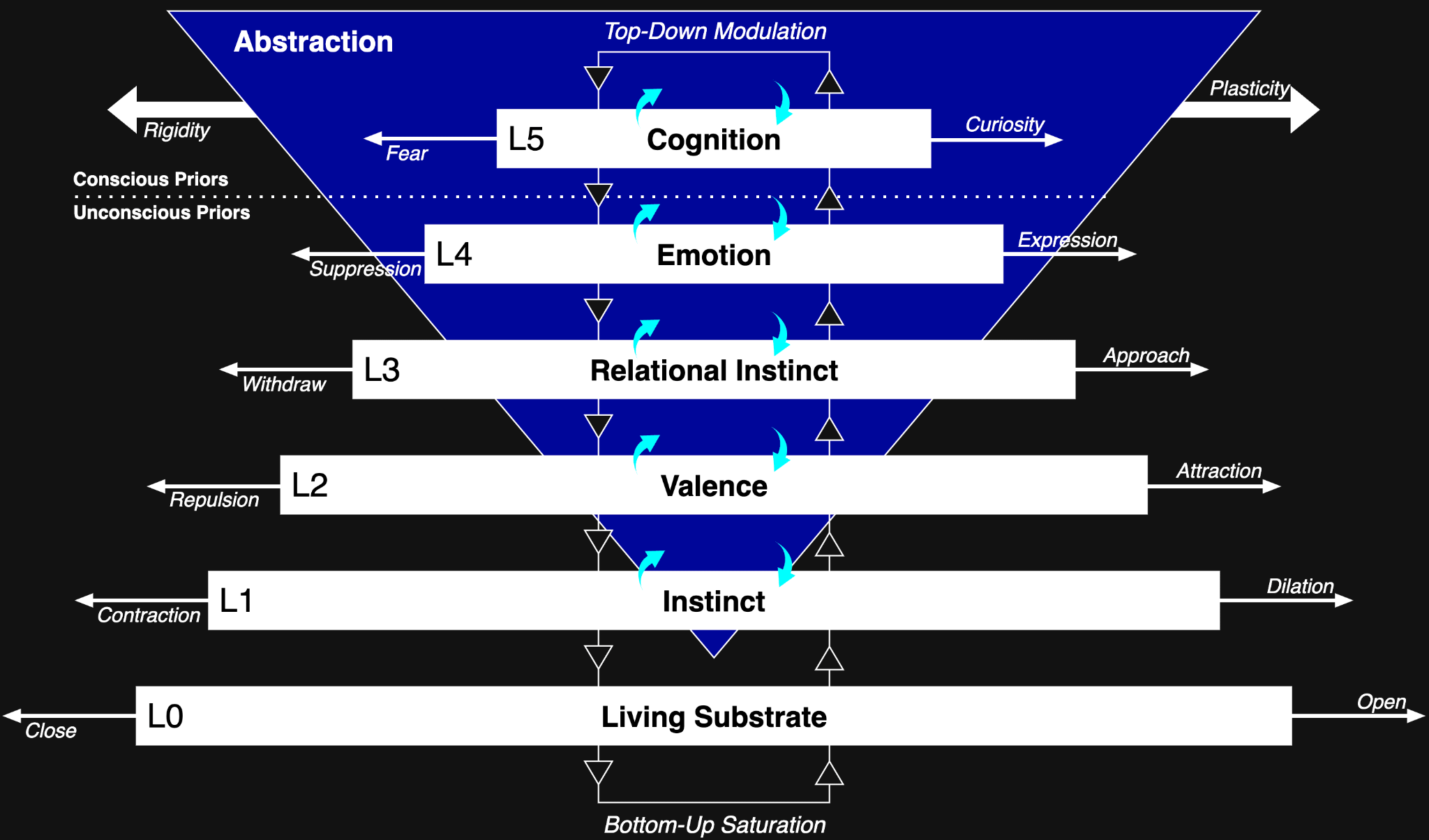
Summary Diagram: The Human Recursion Stack
Basic Signal Flow
Signal flow in the Human Recursion Stack is bidirectional, but asymmetric, governed by recursive update pressure, salience thresholds, and coherence regime dominance. It operates as a stacked loop engine, with each layer modulating its own recursive output based on the processed input from layers below, and subject to override or modulation from layers above.
Bottom-Up Saturation
This is the primary feedforward loop: real-world input is metabolized upward through increasing recursion depth and time-horizon:
Reality→L0
Physical gradients perturb the living boundary (e.g. heat transfer, pressure, chemical concentration shifts, etc.).
L0→L1
Raw homeostatic deviation triggers instinctive responses (e.g. tissue damage → withdrawal reflex).
L1→L2
Patterned motor/sensory loops produce affective valence (e.g. cold skin → “this feels bad”).
L2→L3
Affective gradients modulate social navigation (e.g. warmth from one person → approach).
L3→L4
Repeated relational outcomes shape emotion (e.g. rejection → shame; mirroring → trust).
L4→L5
Emotional patterns inform cognitive evaluation (e.g. shame → interpret self as unworthy).
Bottom-up flow is reality-coupled and continuously admits signals over time. Signal flow cannot be shut off; it either is or it isn’t.
Top-Down Modulation
This is the interpretive override loop, where upper layers modulate, suppress, or reinterpret bottom-up signals to preserve coherence under threat:
A→L5
Constraints placed on recursive modeling: “don’t think that”, “that’s dangerous to believe”.
L5→L4
Rationalization, dismissal, or inhibition of emotional outputs that contradict symbolic self-image.
L4→L3
Emotional suppression to maintain relational scripts (e.g. perform calm when angry).
L3→L2
Social mirroring suppresses natural attraction/repulsion gradients.
L2→L1
Valence-modulated avoidance or habituation may blunt instinctive response.
L1→L0
Chronic gradual top-down override (e.g. working while ill) can erode substrate viability without triggering instinctive protective hijack until the body reasserts itself.
Top-down modulation selectively gates recursion to avoid a collapse in the current coherence regime. It can create long-term misalignment between perceived and actual state, especially when symbolic rigidity overrides bottom-up structural truth.
Functional Summary
Healthy recursion = Bottom-up signals are recursively integrated, top-down modulation remains attentive and adaptive.
Damaging recursion = Top-down symbolic layer enforces rigid coherence, blocks introspection, externalizes suffering, suppresses contradiction, exploits body to sustain performance/social mirroring despite no immediate threat to survival.
Recursion Collapse = Top-down symbolic modulation fails to maintain systemic coherence under persistent structural bottom-up pressure; system collapses and realigns from lower-layer signals upward. How these layers realign depends on whether what occurred was pathologized away or causally integrated.

The Next Steps
Use the free WHAT HOLDS? - LLM Experience Interpreter to begin exploring how the framework helps make sense of your own everyday experience.
Subscribe to this free publication for ongoing, public essays that create entry points into the deeper causes behind all too common experiences (perfectionism, burnout, people-pleasing, etc.), as well as other topics.
Face your fear: Download the map that guides you through recalibration of your own nervous system as an operational manual here: WHAT HOLDS? — The Recursive Logic of Experience: A Manual for Mind. It comes with lifetime updates and the option to join a reader community where I participate, answer questions and gather your feedback for further development.