

Because recursion runs vertically through layers, compressions are almost always multilayered. A single event can simultaneously encode an L1 arousal pattern, an L2 valence bias, an L3 relational posture, an L4 affective tone, and an L5 interpretive framing. These do not store separately. They compress into a coupled structure: a vertical alignment of weightings across layers tied to a particular signal pattern. That structure then recalibrates baseline placement, hijack proximity, and resonance accessibility. Compressed priors are therefore updates in recursion geometry.
Priors can be distinguished into three types.
Indexed Prior (Memory)
An indexed prior begins as a lived event that exceeded the system’s neutral corridor during bottom-up passage through the stack in at least one recursion layer but was still able to flow to L5 without hijack. The organism encountered a salient signal pattern—for example, being called on in class for an answer to a math problem—and the signal propagated upward:
L0 registers no physiological deviation—substrate remains viable, signal passes.
L1 detects no survival relevance—no irrevocable bodily threat imminent or occurring, signal passes.
L2 assigns neutral valence—the body’s environment hasn’t changed suddenly, signal passes.
L3 scans for immediate relational threat cues and finds none—social field reads as stable, signal passes.
L4 checks whether the situation warrants affective overrun—it does not, signal passes.
L5 starts retrieving encoded structure within abstraction to arrive at a solution and top-down modulates the body to share the solution.
Let’s assume the signal of mocking laughter enters the stack bottom-up in return because the error in structuring was fundamental.
L0—living substrate unchanged.
L1—no survival threat detected, unchanged.
L2—no sudden interoceptive environmental shift, valence unchanged.
At L3, relational scanning now detects active potential relational threat cues on all sides. Faces carrying contempt or amusement. An evolutionarily selected, developmentally learned and unconsciously stored prior becomes dominant here: belonging = safety. The same ancestral logic that once read group laughter at an individual as a precursor to ostracism now fires in a classroom. The relational instinct layer generates a powerful withdrawal impulse. The organism wants to disappear to limit the occurring downshift of their perceived status in others’ systems. L3 does not hijack outright—no one is physically attacking—but the withdrawal weighting is strong enough that upper layers receive it as an interpretive constraint.
At L4, this negative weighting from L3 expresses itself as shame. Shame is not incidental here—it is the organism’s evolved social self-monitoring mechanism, designed to rapidly downregulate behavior that has triggered group disapproval, and to motivate repair or concealment before exclusion threatens to become permanent. Shame consolidates as the affective summary: I did something wrong in front of others and they responded with contempt.
At L5, cognition engages—but it enters recursion entirely on the defensive side of arbitration and immediately enters current threat-containment and future damage-limitation. It stores a conscious pointer to this very salient resolution of recursion, something like: “That time I answered wrong in math class, I was exposed as stupid in front of everyone. It was embarrassing.” The episode is encoded vertically across all salient layers—the L3 withdrawal impulse, the L4 shame tone, and the L5 conceptual landscape—all bound together into a single coupled compression. The L5 layer creates a pointer in abstraction acting as a conscious access handle to that entire vertical structure.
The stored compression recalibrates lower-layer weighting and narrows the executable domain available to L5 modeling during similar signal encounters. The initial encounter thereby carries the seeds of a self-fulfilling prophecy. Eventually, expansive curious recursion potentially doesn’t start to materialise again in that domain unless the prior is recalibrated to actual consequence instead of perceived consequence.
De-indexed Prior (Suppressed Memory)
A de-indexed prior begins as an indexed one. The signal propagated through all layers without hijack. L5 participated in encoding. A narrative pointer formed—an episodic access handle to the entire vertical compression. The event is, at least initially, consciously retrievable.
What changes is not the original encoding but what potentially happens over time as the compression is re-entered.
Consider the same child from the previous section. Each time the encoded pointer to the original math event is activated, shame floods the stack. At this point fundamental priors in the stack interpret the repeated systemic destabilization during recall as a threat in and of itself. Recursion is aborted not because the original event was overwhelming—it wasn’t; L5 participated in encoding it—but because re-entry has become reliably destabilizing, and the system’s unconscious governance rules treat that destabilization as something to be avoided. The organism simply does what it evolved to do: repeatedly abort and avoid future destabilizing recursion that is perceived as threat until the system’s arbitration thresholds are recalibrated.
Access to the pointer becomes progressively gated. The narrative handle doesn’t disappear cleanly—it weakens through repeated aborted re-entry and gradual disuse. Over time the specificity of the original episode diffuses upward into a general identity narrative—”I am bad at math”, “I don’t perform well under pressure”, “academic environments aren’t for me”—insulating the system from future destabilization by replacing the retrievable episode with a principle that requires no re-entry to operate. The episodic index loses conscious retrievability not because the compression is gone but because the system has learned that reaching it increases instability, and because unconscious priors have enforced non-use as a near-term stabilizing solution repeatedly until the pointer diffused.
The vertical compression across L3 and L4 remains fully intact. The lower layer weightings continue shaping how congruent signal configurations with the original episode are classified. But L5 no longer has clean access to the origin. What was once episodic—”that time I failed”—has become dispositional: “I’m not academic.” “I don’t perform well under pressure.” “That kind of environment isn’t for me.” The domain itself becomes circumvented. The system routes around the compression rather than through it.
This is the signature of a de-indexed prior: affective destabilization without accessible story. The lower layers activate reliably in response to congruent signal. The withdrawal impulse fires. Shame consolidates. The organism feels the full vertical weight of the compression. But L5 cannot locate its origin cleanly. There is no more “that time when”—only a felt sense that certain configurations are threatening, certain domains are not safe, certain kinds of exposure must be avoided.
Consider the same person now as an adult. A manager unexpectedly asks them to present their findings to a senior team. The signal enters bottom-up.
At L3, the relational field registers evaluative attention from multiple directions simultaneously. The withdrawal impulse activates strongly.
At L4, shame and apprehension consolidate rapidly—disproportionate to anything the present situation objectively warrants.
At L5, cognition engages but finds no clean episodic referent. There is no accessible memory explaining the intensity of the response. Instead, cognition stabilizes through procedural adjustment: “I need more preparation time.” “I work better with advance notice.” “I’m not good at spontaneous presentations.” These are not fabrications—they feel true. But they are rationalizations generated to account for a lower-layer response whose actual origin is no longer retrievable.
The organism is not lying to itself. It is doing what L5 does when affect arrives without story: constructing the most plausible available explanation for a signal whose actual origin has been progressively gated from view.
This is how de-indexed priors start shaping identity. Not through conscious decision but through repeated L5 attempts to account for affective responses whose origins have been obscured by the very governance rules that protected the system from repeated destabilization. The explanations consolidate upward through abstraction —from A1 schemas about specific situations into A2 principles about the self—all while becoming an increasingly permanent part of the coordinate system through which future signal is classified. At that point the distortion is no longer a response to a past event. It has become a feature of how reality is perceived.
Event → indexed prior
Repeated destabilizing recall → pointer gating
Pointer degradation → de-indexed prior
Behavioral constraint → identity abstraction
Unindexed Prior (Trauma)
An unindexed prior forms when a signal crosses the hijack threshold of a recursion layer before the signal reaches L5. Unlike an indexed prior—where signal propagates through all layers and L5 forms a narrative pointer that later serves as an access handle to the entire vertical compression—an unindexed prior cuts off at the layer where the hijack occurred. The compression forms at that layer and below. The layers above it never participate.
Consider a young child at home. The environment is calm. Suddenly, a parent erupts into explosive rage: shouting, slamming a table, stepping toward, and stopping in front of the child with a hostile expression.
The incoming signal enters the stack bottom-up.
L0 registers no physiological compromise—the organism remains intact, signal passes.
L1 detects no irrevocable bodily threat imminent or occurring.
L2 detects no change in the body’s environmental conditions—temperature, nourishment, and physical surroundings remain unchanged, signal passes.
At L3, relational instinct begins scanning the agent field. The cues arriving from the parent are immediately destabilizing: rapid vocal escalation, proximity, dominance posture. The relational field abruptly shifts from safe to hostile.
The L3 threat weighting is extremely strong but signal still propagates upward if historical priors in relation to the approaching agent don’t suggest “physical harm imminent”.
At L4, the system crosses its hijack threshold. The affective layer is unable to causally place the sudden explosive hostility from that agent given prior relational experience, it overruns. Terror floods the organism and L5 doesn’t get to recurse. Execution governance collapses into L4 protective resolution: tears and shame.
L5 never participates in encoding. No narrative pointer forms.
What gets stored is therefore not a memory in the indexed sense. It is a compression spanning the layers that were active during the event: the L3 relational threat posture and the L4 affective overrun. These layers bind together into a survival template linking this configuration of cues—sudden rage from a close relational authority—with immediate protective collapse.
Years later, the adult sits in a workplace meeting. A supervisor suddenly raises their voice sharply and slams a notebook onto the table during an argument.
The signal again enters bottom-up.
L0 remains intact.
L1 detects no irrevocable bodily threat imminent or occurring.
L2 remains unchanged.
At L3, the relational field again registers a familiar configuration: dominant agent, loud voice, abrupt movement. The stored compression activates.
The organism’s affective layer rapidly moves toward the same state that was encoded previously—tight chest, heat, dissociation, appeasement, shutdown.
The system is not recalling an event. It is executing an unconsciously stored prior resolution that was never recalibrated.
Summary Diagram: Prior Types
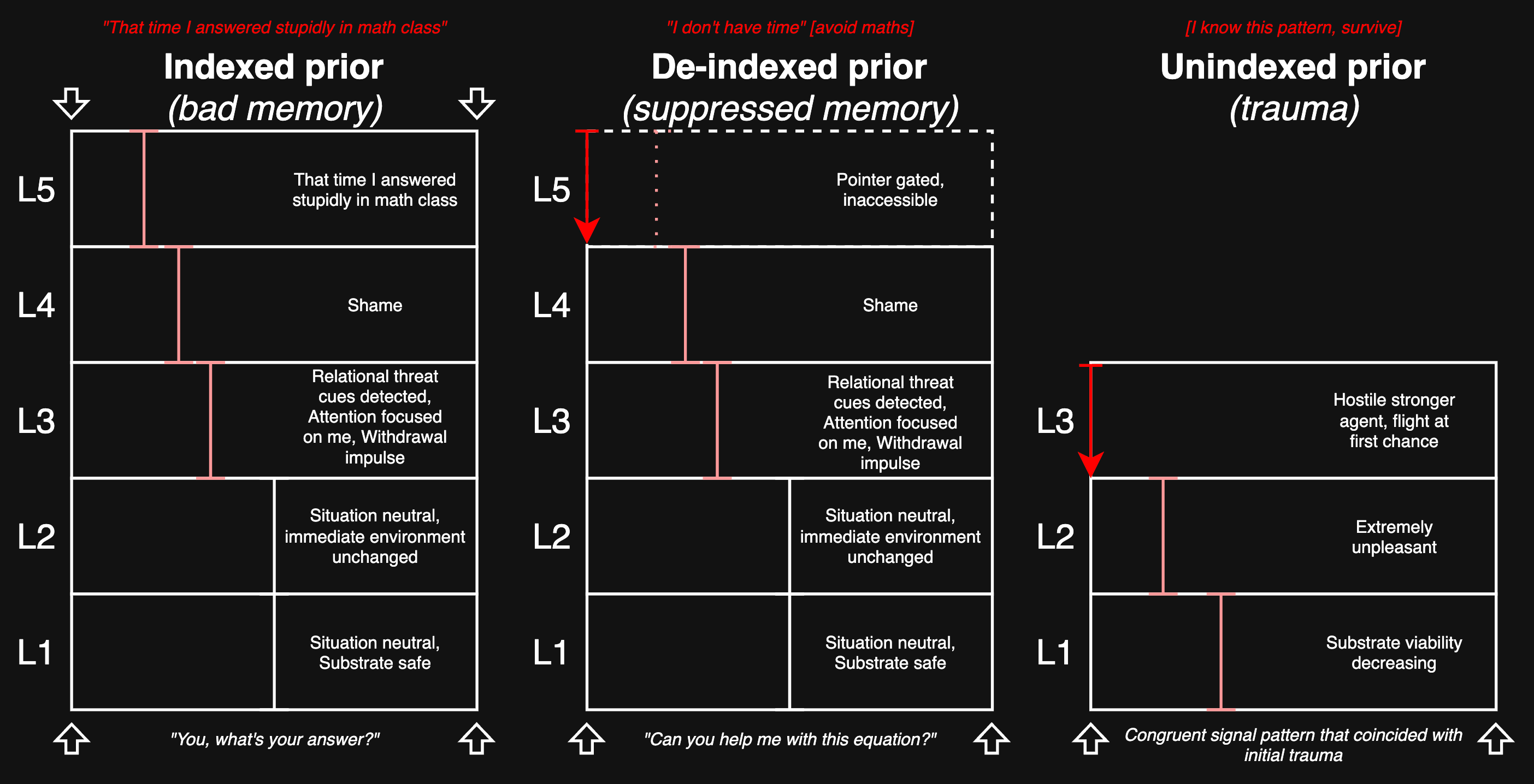
Keep in mind that the picked examples deliberately showcase defensively weighted priors, since these are what need to be focused on in Part II in order to free frozen recursion capacity. Of course there are also integratively weighted priors that boost engagement with certain signal patterns based on recursion history. As distorting compressions that influence the geometry of your perception defensively start to loosen during the descent, the positive priors that have already shaped you to become “who you are” become even more dominant as defensive constraints drop further.

– Learn more about A Thinker In Nature 🌱
– Subscribe to this free publication and receive
Ongoing essays delivered to your inbox that provide a new perspective on small everyday moments, deeper human experiences as well as larger patterns that shape our lives.
Access to the WHAT HOLDS Companion GPT
– Join the journey and download the map that powers this publication, it explains the causality behind experience and guides a process of targeted experiential recalibration:
WHAT HOLDS? — The Recursive Logic of Experience: A Manual for Mind